

The idea of developing a new torpedo boat first emerged among British designers in the late 1930s. They recognized the potential of German boats with powerful armaments and high speeds at relatively low costs. Following the outbreak of World War II, development accelerated with Noel Maclean's proposal. Maclean was a former cavalryman and member of the Dover Patrol from 1916 to 1918. In 1939, he founded Fairmile Marine and submitted a design for a wooden boat to the Admiralty. The boat could be built in piano and furniture workshops. Within a year, this led to the creation of the Fairmile A, followed by the Fairmile B and Fairmile C.
However, by the end of 1940, it became apparent that the new British boats were vulnerable compared to the German ones. They were slower and had more expensive but weaker armaments. Additionally, their torpedoes were ineffective against small, mobile targets. To remedy this, the Admiralty recalled Maclean's longer designs, which had been rejected for minor reasons. By March 1941, the designs had been modified to include a stern similar to that of a destroyer. Almost a year later, the first series of the new Fairmile D boats was ready. The first boat of the fifth and final series (5001–5029) was MTB 5001, which was commissioned on December 18, 1944. Compared to previous series, this one was the heaviest, combining two 18-inch torpedo tubes with two 21-inch ones. MTB 5001 served in the Royal Navy until April 7, 1945, when it was sunk by a German torpedo boat in the North Sea.
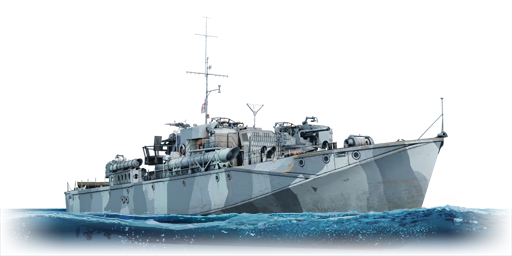
The Fairmile D (5001) was introduced in Update 1.83 "Masters of the Sea". Its artillery armament remained unchanged from its predecessor's, but its torpedo armament changed. The four 450 mm torpedo tubes were replaced with two 533 mm tubes and two 450 mm tubes. The ship still has powerful and numerous weapons; however, it does not stand out in terms of survivability due to its large, wooden hull.

| Ammunition | Type | Armor penetration (mm) at a distance: | |||||
|---|---|---|---|---|---|---|---|
| 100 m | 1000 m | 2000 m | 3000 m | 4000 m | 5000 m | ||
| HE | 6 | 5 | 5 | 5 | 5 | 5 | |
| Belt | Belt filling | Armor penetration (mm) at a distance: | |||||
|---|---|---|---|---|---|---|---|
| 10 m | 100 m | 500 m | 1000 m | 1500 m | 2000 m | ||
| HEF-T/HEF-I/AP-T | 34 | 32 | 26 | 21 | 18 | 16 | |
| AP-T/AP-T/AP-T/HEF-I | 34 | 32 | 26 | 21 | 18 | 16 | |
| HEF-T/HEF-I/AP-T/HEF-I | 34 | 32 | 26 | 21 | 18 | 16 | |
| Belt | Belt filling | Armor penetration (mm) at a distance: | |||||
|---|---|---|---|---|---|---|---|
| 10 m | 100 m | 500 m | 1000 m | 1500 m | 2000 m | ||
| AP/HEI/T | 24 | 24 | 21 | 18 | 16 | 15 | |
| Belt | Belt filling | Armor penetration (mm) at a distance: | |||||
|---|---|---|---|---|---|---|---|
| 10 m | 100 m | 500 m | 1000 m | 1500 m | 2000 m | ||
| IT/AP/AP | 10 | 9 | 8 | 7 | 6 | 5 | |
2 × 450 mm Mk XV torpedo
2 × 450 mm Mk XV torpedo
2 × Mk.VII depth charge


 2 x (110 / 165) %
2 x 136 %
2 x (110 / 165) %
2 x 136 %
Seakeeping |
|---|
Unsinkability | |
|---|---|
Firepower | ||
|---|---|---|