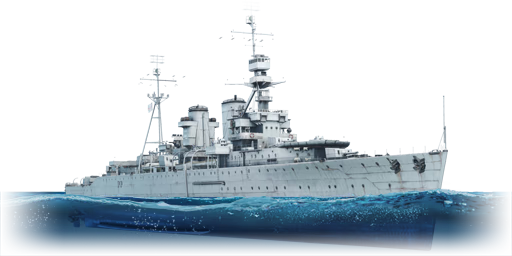
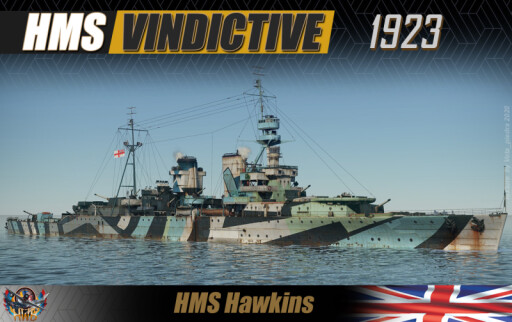
The HMS Hawkins (D86) was the lead ship of a namesake class. The ship was named after Admiral Sir John Hawkins, one of the commanders of the fleet that defeated the Spanish Armada in 1588. Although the ship was laid down in 1916, it did not enter service until after the war ended. Built to counter German raiders, the cruiser was tasked with acting as an "anti-raider" — a destroyer of enemy light cruisers operating on Allied communication lines. These were essentially the world's first heavy cruisers, though the class was not distinguished separately at that time. The Hawkins-class cruisers caused a sensation. Moreover, HMS Hawkins left its mark on history as the benchmark for drafting Articles XI and XII of the Washington Naval Treaty on arms limitation. These articles prohibited the construction of ships with a displacement of more than 10,000 tons or a main armament exceeding 8 inches (203 mm). As a result, all countries abandoned plans to build large ships, such as battleships and battlecruisers, and began competing in the construction of heavy cruisers, known as "Washington cruisers."
It initially served in the Chinese station fleet until 1928. After being refitted and modernized in 1929, it joined the Atlantic Fleet. In 1935, it was placed in reserve. Under the terms of the 1930 London Naval Treaty, it was "demilitarized" from 1937 to 1938, during which time all weapons were removed and the cruiser was reclassified as a training ship. Following the outbreak of World War II, the ship was rearmed and served off the coast of Africa and in the Indian Ocean, primarily performing escort duties for military convoys. In 1947, the ship was sold for scrap.
The HMS Hawkins was introduced in Update 1.93 "Shark Attack" in its 1942 modification. The cruiser has decent anti-aircraft defenses and armor but low survivability and slow speed compared to other cruisers.