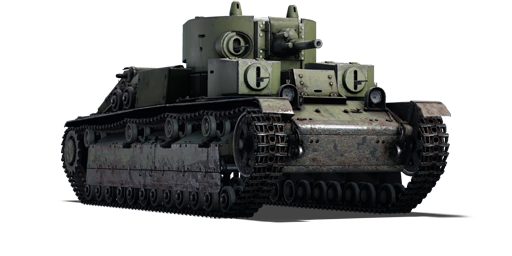
T-28
The T-28 was a series of multi-turreted tanks developed in the Soviet Union. Although only one prototype was built in 1926, the British Independent tank greatly influenced many countries during the interwar period, including the USSR. The project began in 1930, when Soviet representatives visited the UK to acquire the most modern tanks, showing particular interest in the Independent tank. When the British refused to sell it, the Soviets were forced to develop their own design.
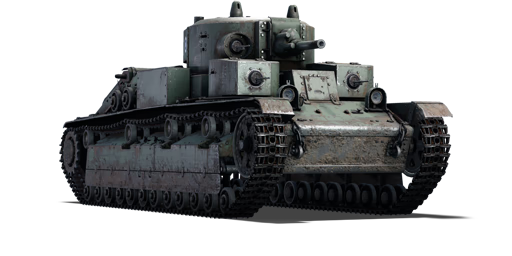
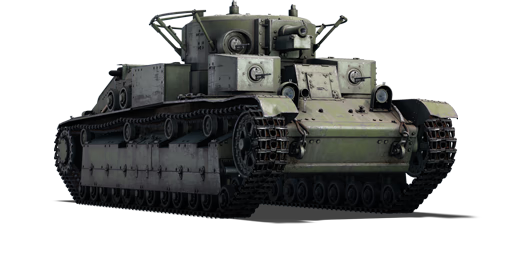
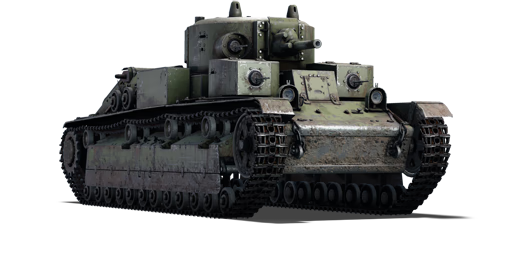
The T-28 was created in 1931 by the VOAO bureau, drawing on Soviet-German experience and earlier prototypes such as the T-22 and T-24. After testing a prototype in 1932 and revising the design, the USSR approved it for serial production in October 1932, which began at the Leningrad factory in 1933. Between 1933 and 1941, 503 tanks were built in different variants, all sharing the same layout: a large main turret accompanied by two smaller DT turrets positioned on either side of the driver’s hatch. Early models, such as the T-28A, were armed with the low-velocity KT-28 gun, while later T-28B models featured the improved L-10 gun, and some tanks were equipped with an additional roof-mounted machine gun on the main turret. Following the Winter War, it became clear that the original armour was too thin, leading to the T-28E variant with additional armour plates. The chassis was also used for several prototypes, including the SU-8 (essentially the chassis with all components removed and fitted with a 152 mm naval gun), a bridgelayer (IT-28), a mine-roller tank, and a flame-throwing variant (OT-28). There were even attempts to integrate Christie suspension to improve mobility, but these experiments never advanced beyond the prototype stage.
T-28 tanks were used in many conflicts. In the early stages of the Winter War, the T-28 was mainly used to attack enemy fortified positions and pillboxes. Because the armour was too thin, upgrades were initiated. The up-armoured versions were used to break through the main Finnish defensive fortification, the Mannerheim Line. Around 200 T-28 tanks were knocked out during the war with Finland, but only about 20 of them were irrecoverable. During the Winter War and the Continuation War, Finland captured seven T-28 tanks. However, because the Finns did not have tractors that could tow them, most of them had their machine guns, radios, and other components removed and were then left abandoned. At the start of Operation Barbarossa, the Soviets had 411 T-28 tanks in service. However, most of them were lost in the first months of the invasion. Still, some survived and took part in the defence of Moscow and Leningrad. Today, three T-28s remain: two are in Finland and one is in Moscow.