
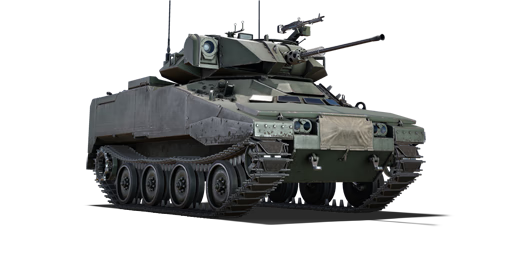



By the start of the Vietnam War, the U.S. Army had two main types of armored vehicles: the M113 armored personnel carrier and the M114, a smaller reconnaissance vehicle. While the M113 performed well in combat, the M114 was deemed unreliable and quickly withdrawn from combat units. In search of a replacement and working on new armored vehicle designs, the US Army initiated several armored vehicle development programs. One of these programs was the XM800 Armored Reconnaissance Scout Vehicle, which was launched in the 1970s and sought to create lighter, faster vehicles with better combat capabilities.
This program involved constructing a small reconnaissance vehicle with cannon armament. Two variants were selected as a result of the competition: a wheeled vehicle from Lockheed Missiles, designated XM800W, and a tracked vehicle from FMC, designated XM800T. By 1974, four prototypes of each version had been built, and comparative tests had begun. The XM800T proved slightly superior, partly due to its excellent off-road mobility. However, the program was shut down in 1975 due to military budget cuts and the prioritization of developing a full-fledged infantry fighting vehicle, which later became the M2 Bradley.
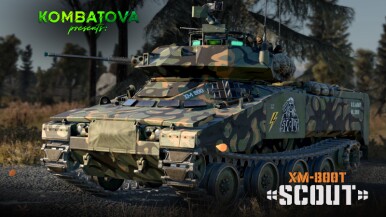
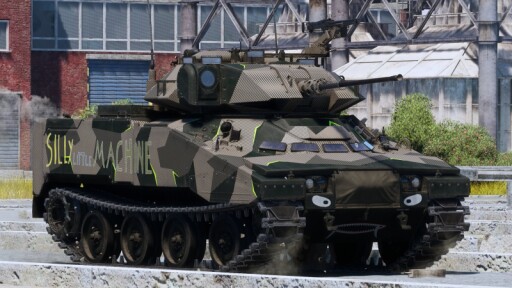
Introduced in Update 2.37 "Seek & Destroy", the XM800T excels in speed, outpacing nearly all other vehicles in its rating. However, its high velocity makes it prone to flipping, so players must exercise caution. Its quiet engine makes it effective for ambushes, and the fast-firing autocannon can easily eliminate light and medium targets. While the tank can avoid heavy tanks thanks to its excellent manoeuvrability, players should be mindful of its thin armour, which makes it vulnerable to aerial attacks. Although the 20 mm gun can also be used as an anti-aircraft weapon, be wary of the low ammunition count.

| Belt | Belt filling | Armor penetration (mm) at a distance: | |||||
|---|---|---|---|---|---|---|---|
| 10 m | 100 m | 500 m | 1000 m | 1500 m | 2000 m | ||
| HVAP-T/HEI-T | 57 | 52 | 37 | 24 | 15 | 10 | |
| HEI-T/HEI-T/HEI-T | 6 | 6 | 4 | 3 | 2 | 2 | |
| HVAP-T/HVAP-T/HVAP-T | 57 | 52 | 37 | 24 | 15 | 10 | |
| APDS/APDS/APDS | 66 | 64 | 58 | 50 | 44 | 38 | |
| Belt | Belt filling | Armor penetration (mm) at a distance: | |||||
|---|---|---|---|---|---|---|---|
| 10 m | 100 m | 500 m | 1000 m | 1500 m | 2000 m | ||
| AP/T | 13 | 12 | 7 | 3 | 2 | 0 | |


Mobility | |
|---|---|
Protection |
|---|
Firepower | ||
|---|---|---|