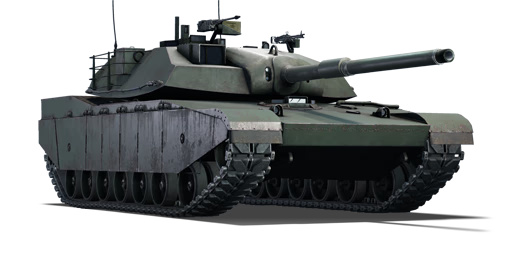
The XM1 project aimed to develop an American main battle tank, which became the basis for the M1 Abrams tank. Development of the XM1 began immediately after the MBT-70 and XM803](/unit/us_xm_803) program were canceled at the end of 1971 due to their high cost. In addition to being cost-effective, one of the new vehicle's key objectives was to provide a high level of protection. The tank's armor had to be able to protect from Soviet 115 mm U-5TS gun at a distance of 800 meters. Two corporations, General Motors and Chrysler, undertook the project. After a long process of transforming concepts and drawings into fully operational combat vehicles, both companies presented their tank prototypes for trials in February 1976.
In the end, the General Motors prototype lost the competition to Chrysler’s design. Chrysler’s decision to replace the diesel engine in its prototype with the AGT-1500 gas turbine was the key factor in General Motors’ failure. At the time, gas turbine engines were considered too immature, unreliable, and unsuitable for production tanks. Nevertheless, Chrysler’s risky move paid off—their prototype was chosen over General Motors'. General Motors' attempts to replace the diesel engine with the AGT-1500 only increased the project's cost. Ultimately, this put an end to the rivalry between the two corporations, and Chrysler was awarded the contract for the continued development of the new tank. By 1978, Chrysler had built 11 pre-production XM1 vehicles for testing and refinement. In 1980, the tank was adopted into service as the M1 Abrams, named after General Creighton Abrams, and mass production began.
The XM1 (Chrysler) was introduced in Update 1.79 "Project X" and it used to be exclusive to the Xbox platform. Although the tank does not feature heavy armor, its strengths lie in its speed and maneuverability, making it effective for flanking maneuvers and capturing key positions. It is equipped with a thermal imager and a laser rangefinder, allowing it to effectively engage targets at range. Despite its weak armor, the tank has fairly good survivability on the battlefield, largely thanks to its spacious interior and the placement of ready ammunition storage in the turret's rear with blowout panels that can save the crew and vehicle from destruction if the ammunition is hit.