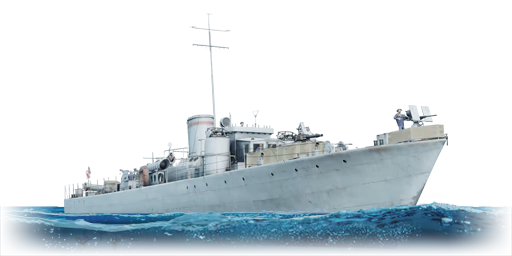


In October 1940, the William Denny and Brothers shipyard received an order to design a small, high-speed, steam gunboat to combat the German torpedo boats known as Schnellboats that were operating with impunity off the coast of Great Britain. The shipyard quickly completed the design, creating a fairly large ship with a full displacement of 202 tons. Steel was chosen for the hull because wood was not suitable for the mass production of ships of this size. Initially, 60 ships in this series were planned, but a shortage of steel and turbines, as well as the successful trials of the more compact, cheaper, wooden Fairmile D, reduced the series to seven units.
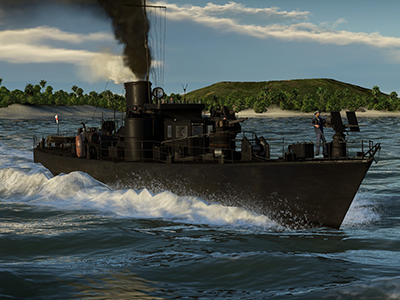
The last ship in the series built was the SGB 9. Laid down on January 23, 1941, it entered service on July 4, 1942, and was named the Grey Goose in 1943. The boats in the series were not initially equipped with fixed armaments and their weaponry could change over time. Initially, they were equipped with a 76 mm QF gun, a 57 mm gun, and three 20 mm Oerlikon guns. However, on some boats, the 57 mm gun in the bow was later replaced with a 40 mm QF gun and some of the 20 mm guns were removed for various reasons. In 1944, the Grey Goose was reclassified as a high-speed minesweeper for sweeping non-contact mines. After the war, it became a test vessel for the Vosper company. In 1955, new Rolls-Royce RM60 turbines were tested on the Grey Goose. Grey Goose was sold to a civilian owner in 1958, and its hull was converted into a houseboat in 1984. The ship is now moored on the River Medway and bears the name Anserava.
The SGB Grey Goose was introduced as one of the rewards for the 2020 Space Race event. The ship has powerful artillery, good mobility, and high survivability. Among its disadvantages is the large angle of installation of the torpedo tubes.

| Belt | Belt filling | Armor penetration (mm) at a distance: | |||||
|---|---|---|---|---|---|---|---|
| 10 m | 100 m | 500 m | 1000 m | 1500 m | 2000 m | ||
| HEF/AP-T/HEF/AP-T | 60 | 57 | 50 | 43 | 38 | 34 | |
| HEF/HEF/HEF/AP-T | 60 | 57 | 50 | 43 | 38 | 34 | |
| AP-T/AP-T/AP-T/HEF | 60 | 57 | 50 | 43 | 38 | 34 | |
| Belt | Belt filling | Armor penetration (mm) at a distance: | |||||
|---|---|---|---|---|---|---|---|
| 10 m | 100 m | 500 m | 1000 m | 1500 m | 2000 m | ||
| HEF-T/AP-T | 34 | 32 | 26 | 21 | 18 | 16 | |
| Ammunition | Type | Armor penetration (mm) at a distance: | |||||
|---|---|---|---|---|---|---|---|
| 100 m | 1000 m | 2000 m | 3000 m | 4000 m | 5000 m | ||
| HE | 12 | 10 | 9 | 8 | 7 | 7 | |
| Shrapnel | 11 | 10 | 9 | 8 | 7 | 7 | |
| Belt | Belt filling | Armor penetration (mm) at a distance: | |||||
|---|---|---|---|---|---|---|---|
| 10 m | 100 m | 500 m | 1000 m | 1500 m | 2000 m | ||
| AP/HEI/T | 24 | 24 | 21 | 18 | 16 | 15 | |
4 × 1123/1323 lbs Type M Mark I moored contact mine


 2 x (90 / 135) %
2 x 148 %
2 x (90 / 135) %
2 x 148 %
Seakeeping |
|---|
Unsinkability | |
|---|---|
Firepower | ||
|---|---|---|