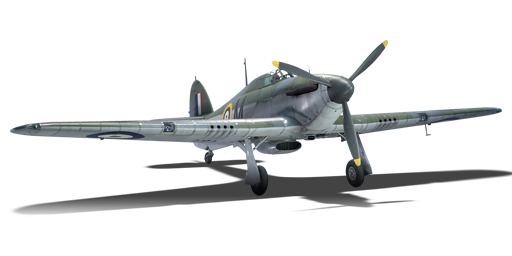


The Hurricane Mk. I/L was a British single-engine fighter developed during World War II by Hawker Aircraft under the direction of Sydney Camm. The Mk.I/L (Late) variant, an improved version of the standard Mk.I, featured metal-covered wings, added armor protection, and a three-bladed, variable-pitch, metal propeller. Production of the Late Hurricane Mk. I took place from 1940 to 1941 in the United Kingdom and Canada. Canadian-built aircraft were shipped to Britain. Approximately 400 aircraft were produced. Hurricane Mk.I/L fighters saw extensive service with the Royal Air Force (RAF) during World War II, particularly during the Battle of Britain. They formed the backbone of RAF Fighter Command and played a major role in repelling the German air offensive.
The Hurricane Mk.I/L FAA M was introduced in honor of the 80th anniversary of the Battle of Britain. The only difference between the FAA M and the standard Hurricane Mk.I/L is its unique camouflage scheme, which matches that used on Fleet Air Arm training aircraft. With effective armament, a large amount of ammo, and excellent maneuverability, it is well suited for turning engagements against enemy fighters. However, the Hurricane's speed leaves much to be desired, making it difficult to catch some opponents. This disadvantage becomes even more pronounced at higher altitudes. Additionally, the relatively low firepower of its 7.7 mm machine guns makes engaging bombers and armored targets challenging.

flaps
flaps
flaps
brake
| Belt | Belt filling | Armor penetration (mm) at a distance: | |||||
|---|---|---|---|---|---|---|---|
| 10 m | 100 m | 500 m | 1000 m | 1500 m | 2000 m | ||
| T/AP/AP-I/Ball/Ball/I | 13 | 12 | 7 | 3 | 2 | 0 | |
| T/AP/AP-I/AP-I/I | 13 | 12 | 7 | 3 | 2 | 0 | |
| IT/AP-I | 13 | 12 | 7 | 3 | 2 | 0 | |
| AP-I/AP-I/I | 13 | 12 | 7 | 3 | 2 | 0 | |


 2 x (40 / 120 / 165) %
2 x 118 %
2 x (40 / 120 / 165) %
2 x 118 %
Flight performance | |
|---|---|
Survivability |
|---|
Weaponry |
|---|