
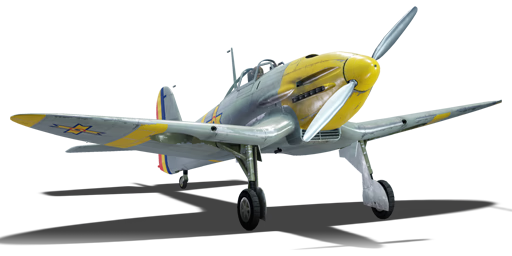
He 112 B-1/U2




The Heinkel He 112 was the Bf 109's main competitor in the race to become the Luftwaffe's primary production fighter. Despite positive experience in Spain, where He 112 pilots supported the Francoists as part of the Condor Legion, the Bf 109 ultimately won out because it was cheaper and easier to manufacture. Although the Heinkel was much more aerodynamically advanced and only needed a new engine, the Bf 109 went into production earlier, and all new engines were reserved for it. After that, the He 112 was effectively "shelved". However, Ernst Heinkel continued to improve the aircraft, managing to export several to Romania and Hungary. The aircraft also attracted the interest of a Japanese delegation, and four were sent to Japan for testing. Only the Romanian He 112s participated in combat operations. However, due to their use as attack aircraft, they were not very effective and suffered high losses.
For the B series aircraft, Ernst Heinkel first decided to completely redesign the airframe to compensate for the lack of powerful engines and second to significantly strengthen the armament. The first variant, the He 112 B-0 (V9), featured clean aerodynamic shapes and a pair of machine guns and 20mm wing cannons. At the time, this was nearly the most powerful armament for a single-engine interceptor. Two export modifications were created from this model: the B-1 and B-2. The He 112 B-1 was distinguished by its Jumo 210D engine, while He 112 B-1/U2 featured the Jumo 210E. These aircraft were exported to Spain, Romania, and Hungary. Romania purchased 30 fighters that actively participated in combat operations on the Eastern Front. Toward the end of their service, the aircraft were used for air defense over large Romanian cities but were not very successful. Even after 1943, when the surviving aircraft were withdrawn from combat units, their service was not over. They were transferred to training units and were in service until 1947.
The Romanian He 112 B-1/U2 was introduced in Update 2.17 "Danger Zone" as a part of the Italian air research tree. While its characteristics are similar to those of the He 112 B-0, it has a different engine and the light camouflage of the Romanian Air Force. It carries serious armament, posing a threat to any opponent, including multi-engine bombers. The He 112 B can “outmaneuver” many aircraft in horizontal turns and perform even better in when diving down on enemies from above. Few fighters can boast such a Max speed; therefore, diving is also an effective way to escape pursuit because the Heinkel's horizontal speed is unimpressive.

flaps
flaps
flaps
brake
| Belt | Belt filling | Armor penetration (mm) at a distance: | |||||
|---|---|---|---|---|---|---|---|
| 10 m | 100 m | 500 m | 1000 m | 1500 m | 2000 m | ||
| IT/IT/APHE | 15 | 13 | 8 | 4 | 4 | 4 | |
| IT/FI-T/FI-T/APHE | 15 | 13 | 8 | 4 | 4 | 4 | |
| FI-T/FI-T/AP-I/APHE/IT | 20 | 17 | 10 | 5 | 3 | 2 | |
| IT/IT/FI-T/FI-T | 7 | 7 | 4 | 3 | 2 | 1 | |
| APHE | 15 | 13 | 8 | 4 | 4 | 4 | |
| Belt | Belt filling | Armor penetration (mm) at a distance: | |||||
|---|---|---|---|---|---|---|---|
| 10 m | 100 m | 500 m | 1000 m | 1500 m | 2000 m | ||
| AP-T/AP-I/AI | 9 | 8 | 6 | 3 | 0 | 0 | |
| AP-T/AP/AI/AP-I | 13 | 12 | 7 | 3 | 2 | 0 | |
| AP-T | 9 | 8 | 6 | 3 | 0 | 0 | |
| AI/AP/AP/AP/AI | 13 | 12 | 7 | 3 | 2 | 0 | |

 2 x (30 / 60 / 350) %
2 x 112 %
2 x (30 / 60 / 350) %
2 x 112 %
Flight performance | |
|---|---|
Survivability |
|---|
Weaponry |
|---|